Why Is Process Street the Best for Data Integration?
Most teams lose hours each week copying data between compliance tools, audit logs, and policy folders. They watch records drift out of sync and still need to prove every control passed inspection at the end of the month. These gaps turn small mismatches into major audit findings.
By the end of this article you will see how Ops, Docs, and Cora handle those hand-offs in one platform, where the pricing tiers start, and which organizations gain the most coverage from a single compliance system rather than stitching three separate vendors together.
What Is Process Street?
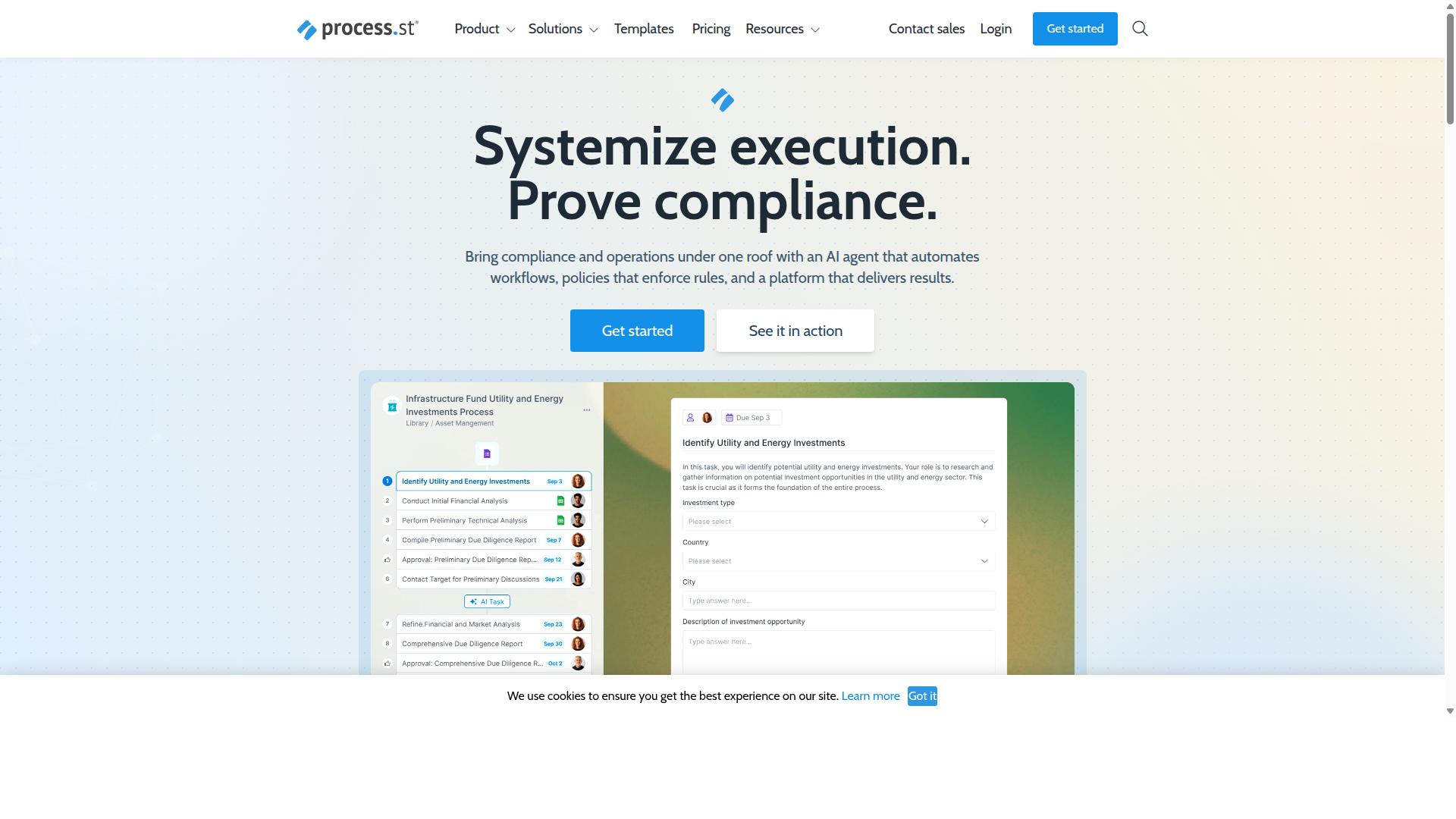
Process Street is a compliance operations platform that automates business processes and enforces policies with audit-ready proof.
The platform combines document management, workflow automation, and compliance enforcement in one system. Organizations use it to create consistent procedures across departments while maintaining detailed records for audits and reviews.
Three main products work together to deliver these capabilities. Docs handles document management and policy control. Ops manages workflow automation and process orchestration. Cora serves as an AI compliance and risk agent that monitors processes for potential issues.
These three products connect to support standardized, auditable processes throughout an organization. Documents stay version-controlled while workflows execute automatically. Cora adds intelligent oversight that catches compliance gaps before they become problems.
More than 3,000 companies rely on this integrated approach to maintain operational consistency across different industries and regulatory environments.
Why Process Street Excels at Data Integration
First sentence: Process Street connects to existing business systems through native connectors, REST APIs, and webhook triggers that maintain data consistency across platforms.
Strong data integration begins with secure connections. REST API endpoints let teams link external systems directly to workflows. OAuth authentication protects each connection by confirming user identity before any data moves.
Real-time updates happen through webhook triggers that push changes instantly into active processes. This approach keeps records current without manual refreshes or scheduled jobs.
Teams often need to move bulk records. CSV import and export handles large files quickly. JSON parsing reads complex data structures so nested information stays organized during transfer.
Many businesses already run CRM and ERP systems. Native connectors make these links direct, reducing setup steps and keeping records aligned between platforms.
Errors can break connections. Built-in error handling mechanisms catch failures early and log the details. Data validation processes check each record before it reaches the destination, cutting down on mismatched fields or incomplete entries.
These features work together to support reliable data synchronization. The combination of secure access, flexible formats, and strong validation allows teams to trust that information stays consistent across every connected system.
Key Features and What Makes Process Street Stand Out
Process Street's three core products each address specific aspects of business process management and compliance requirements.
These products work together to handle data integration challenges that many organizations face daily. Each component connects with external systems through built-in integrations that include Zapier, Microsoft Power Automate, Tray.io, Make, and Public API access.
The platform serves 3,000+ companies and 1m+ users across various industries. This scale demonstrates how the three products combine to create comprehensive data workflows that maintain accuracy throughout each process.
Ops: Workflow Automation and Process Orchestration
Ops transforms static policies into AI-powered workflows that orchestrate tasks across teams and systems.
Conditional logic and task dependencies automate manual processes by routing information based on specific criteria. Automated triggers respond to events in connected systems, which reduces the time needed to move data between platforms.
Process AI capabilities within Ops handle routine data transformations without requiring manual intervention for each step.
Task automation features ensure consistent data flow across different SaaS platforms. The system maintains data validation rules that catch errors before they affect downstream processes or reporting dashboards.
Cora: AI-Powered Compliance Monitoring
Cora continuously monitors compliance requirements and automatically generates audit-ready documentation.
The AI compliance agent tracks policy adherence across all connected systems and maintains version control for process documentation. Real-time monitoring flags potential risks before they impact data governance standards.
Audit trail capabilities support SOC 2 Type II and ISO 27001 certification requirements that many organizations need for data integration projects. These features ensure data synchronization activities meet regulatory standards without additional manual oversight.
Cora operates 24/7 to maintain compliance across multiple regulatory frameworks. This continuous monitoring reduces the risk of data handling violations during integration processes between different business systems.
Docs: Document Management and Policy Control
Docs provides centralized document management with full governance controls for regulatory frameworks including ISO 9001, SOC 2, SOX, and FDA requirements.
Version control ensures team members access current, approved documents rather than outdated versions that could contain incorrect integration procedures. Approval workflows maintain proper authorization for any changes to data handling protocols.
Access permissions protect sensitive integration credentials and data mapping specifications from unauthorized changes.
Centralized storage eliminates version conflicts that often occur when teams work with multiple document sources. This approach maintains consistency across data governance policies that apply to integration activities between various platforms.
Pricing and Plans
Process Street offers three pricing tiers designed to accommodate different business sizes and integration complexity requirements.
The Startup plan serves as a simplified version of the Pro plan. This tier includes unlimited workflows and tasks, 5,000 Data Set records, 5 users, 10 guests, 10 automation apps, and 100 automation actions per month.
Teams also receive Public API access with 50 calls per month under this plan. The Startup plan provides a 14-day free trial on the Pro plan without requiring a credit card.
The Pro plan supports teams that need to transform knowledge into actionable workflows. This tier offers unlimited workflows and tasks, 10,000 Data Set records, and custom user and guest access.
Teams gain access to all automation apps and can customize automation actions and API calls based on their specific data integration needs.
The Enterprise plan delivers a scalable operational knowledge repository for larger organizations. This tier provides custom Data Set records, unlimited Public API access, and dedicated Success Manager support.
Enterprise customers receive priority support, fully-managed workflows, custom integrations, and bulk document import capabilities. Additional benefits include process consulting, health audits, and personalized team training.
These pricing tiers align directly with data integration requirements across different organization sizes. The Startup plan suits smaller teams with limited integration volume, while Pro handles growing data needs with custom automation capabilities.
Enterprise organizations benefit from unlimited API access and dedicated support for complex data synchronization across multiple systems and departments.
Trust Signals
Process Street maintains SOC 2 Type II and ISO 27001 certifications while serving over 3,000 companies worldwide.
These compliance standards ensure data integration workflows meet strict security requirements. Organizations can trust that sensitive business data remains protected throughout every synchronization process.
The platform also holds HIPAA compliance with BAA available upon request. GDPR and CCPA standards further protect user information across global operations.
Over 1 million users rely on Process Street for their workflow automation needs. This adoption reflects consistent performance in handling complex data integration scenarios.
Customer satisfaction reaches 98 percent across the user base. Support teams maintain a five-minute average response time for technical inquiries.
Additional certifications include AWS CIS compliance and availability through the AWS Marketplace. Data never trains AI models, preserving information confidentiality during integration tasks.
These trust signals demonstrate Process Street commitment to security excellence. Companies can confidently implement data integration workflows knowing their information stays protected by industry-leading standards.
Who Should Use Process Street
Process Street serves Operations, Customer Management, Compliance, HR, Finance, and IT teams across Financial Services, Real Estate, Manufacturing, Healthcare, Professional Services, and Technology industries.
Operations teams rely on data integration to connect workflow automation with ERP systems and cloud storage platforms. They use Process Street to maintain accurate records across multiple data sources during production cycles and inventory management.
Customer Management departments benefit from CRM integration features that sync client information automatically. When new accounts are created, data flows between systems without manual entry, reducing errors during client onboarding processes.
Compliance teams in Financial Services and Healthcare use Process Street for ISO compliance and document control workflows. Data integration ensures audit trails remain current across all connected databases and reporting systems.
HR departments handle employee onboarding through synchronized data pipelines that connect to existing HRIS platforms. New hire information updates automatically across payroll, benefits, and security systems without separate data entry steps.
Finance teams in Capital Markets and Property Management use data integration to maintain consistent records between accounting software and workflow tools. This connection supports accurate reporting and reduces discrepancies between financial systems.
IT and Security teams rely on API connectivity and webhook triggers to monitor system health and access permissions. Data validation features help maintain security standards across all integrated SaaS platforms and database connections.
Manufacturing and Real Estate professionals use quality tracking workflows that pull data from production systems and property management tools. Process Street coordinates these data streams to maintain compliance standards and operational efficiency.
Final Verdict
Process Street combines workflow automation, document governance, and compliance monitoring into a single platform that scales from startups to enterprise organizations.
The platform excels at data integration through its native connectors and API connectivity. Organizations can connect SaaS platforms, CRM integration systems, and ERP systems without complex custom coding.
Process Street supports ETL processes and data transformation through its webhook triggers and REST API capabilities. Data mapping and data synchronization happen automatically across connected systems.
Users benefit from real-time updates when data changes occur in source systems. The platform handles data validation and error handling to maintain data quality throughout the integration process.
Process Street offers contact sales options for organizations evaluating data integration needs. The platform appears on AWS Marketplace for easy procurement through existing vendor relationships.
Support comes through email and chat channels with a 5 minutes average response time. The service maintains a 98% customer rating across these support interactions.
Database connectivity and cloud storage integration allow organizations to build comprehensive data pipelines. This infrastructure supports business intelligence and reporting dashboards without additional middleware.
Task automation and conditional logic handle data governance requirements while maintaining compliance standards. Version control and audit trails ensure data integrity across all integrated systems.
Recommended Resources: