Keyword Research: Scalenut or Autoblogging.ai?
You are comparing two tools for keyword research and need a straight answer, not a feature dump. Pick the wrong one and you either burn credits on thin keyword lists or spend hours moving data between tabs before a draft exists. Both platforms promise research-to-draft speed, so the difference lives in the details.
This article compares Autoblogging.ai and Scalenut on SERP competitor analysis, LSI keyword extraction, language coverage, and pricing. You will see how each handles the jump from a keyword to a published draft, and which plan gives better rollover value. By the end you will know which tool fits your blog, site, or agency workflow.
Quick Verdict: Scalenut or Autoblogging.ai for Keyword Research?
If you need deep keyword research with a built-in content editor, Scalenut is a strong pick; if you want to turn keywords into publish-ready articles at scale, Autoblogging.ai is the faster route.
The core difference comes down to where the workflow ends. Scalenut is generally built around research and optimization, helping writers explore topics, assess search intent, and refine drafts before publishing. Autoblogging.ai takes a different path, connecting research inputs to finished drafts so the output is ready to publish rather than ready to edit.
That distinction matters most when content volume is the bottleneck. Teams producing a handful of high-touch articles per month may prefer a research-first tool, while anyone managing multiple sites, niche projects, or affiliate content pipelines tends to feel the drag of a manual handoff between keyword list and draft.
Autoblogging.ai's credibility here is worth noting. It is trusted by 40,000+ content creators and carries a 4.9 average rating, with 1M+ articles generated to date. Those numbers do not prove it is right for every use case, but they do suggest a large base of users has found the research-to-draft approach workable at scale.
For this article's target reader, the practical takeaway is straightforward. If your goal is a research workspace with optimization guidance, Scalenut deserves a look. If your goal is to move from keyword to published article without rebuilding the workflow at every step, Autoblogging.ai is the stronger fit.
At a glance: how Autoblogging.ai compares to Scalenut on the features that matter most.
| Feature | Autoblogging.ai | Scalenut |
|---|---|---|
| Keyword Research | ✓ | ✓ |
What Is Autoblogging.ai?
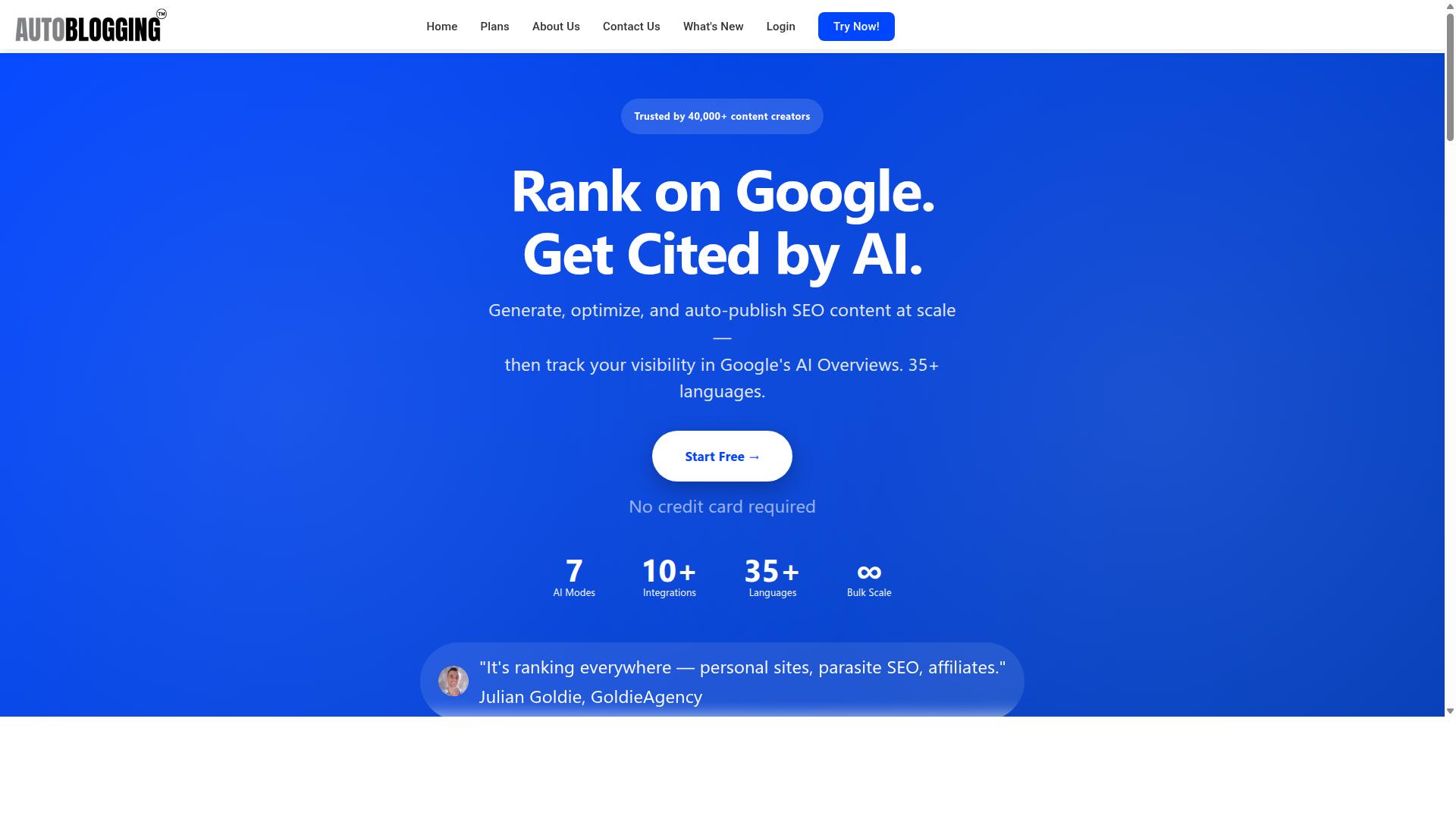
Autoblogging.ai is an AI article generation platform designed to help bloggers, agencies, and affiliate marketers produce content at scale without sacrificing SEO quality. It is a product of Digimetriq.com, built on a straightforward mission: help bloggers, website owners, and agencies save time and improve their online presence through cutting-edge technology.
Where many tools in the SEO space focus on one narrow job, Autoblogging.ai approaches content creation as an end-to-end workflow. The platform is built to cut down content costs and give the power to human counterparts in standard operating procedures with a strong first draft. Digimetriq's longer-term aim goes further, toward replacing certain human counterparts entirely for repetitive publishing tasks.
That positioning matters when you are comparing tools for keyword research and content production. A keyword tool tells you what to write about. An article generator like Autoblogging.ai is built to act on that information and produce the draft itself, which shortens the gap between research and a published post.
The platform offers several distinct generation modes so users can match output to the job at hand:
- Quick Mode for fast draft generation
- Godlike Mode for longer, more detailed articles
- Bulk Generation for producing many articles at once
Autoblogging.ai supports 35+ languages and a range of integrations, which makes it practical for multi-market sites and agencies serving clients in different regions. It is used by 40,000+ content creators and has generated over 1 million articles, a volume that speaks to how many teams treat it as a core part of their publishing stack rather than an occasional experiment.
For readers weighing Scalenut against Autoblogging.ai, the distinction is worth keeping clear. Scalenut is generally known as an SEO and content marketing suite with research and optimization features. Autoblogging.ai is purpose-built around automated article generation at scale, which is why it tends to appeal to niche marketers, affiliate marketers, and agencies who need volume without expanding headcount.
What Is Scalenut?

Scalenut is an AI-powered SEO and content marketing platform that combines keyword research, content optimization, and writing assistance in one dashboard. It is generally positioned as an all-in-one workspace where a writer or strategist can move from a seed term to a finished draft without switching between several separate applications.
The platform tends to appeal to SEO professionals and content teams who want research and drafting to live in the same place. Rather than juggling a keyword tool, a brief builder, and a separate editor, users work inside a single interface that carries data from one stage to the next.
Its core capabilities are typically grouped into a few areas:
- Keyword research: discovering terms, reviewing search volume, and gauging keyword difficulty
- SERP analysis: examining what already ranks to understand search intent and competitor angles
- Content briefs: assembling outlines and guidance before a draft is written
- AI writing assistance: generating and refining copy inside the same workflow
Scalenut leans on natural language processing and machine learning to support these tasks. That combination is common among modern SEO tools, and it is what allows a platform to suggest related terms, cluster topics, and score a draft against a target keyword.
For teams focused on content optimization and semantic SEO, this kind of integrated environment can reduce friction. A strategist can research a topic, review competing pages, and hand a structured brief to a writer without exporting anything.
It is worth noting that Scalenut is a general-purpose platform. It supports many workflows, which means it carries many features, and some users find that breadth requires a learning curve. Tools built for everyone tend to be less specialized than tools built for one specific job.
That distinction matters in a comparison like this one. Scalenut is designed as a broad SEO and content suite, while a platform focused on blog automation narrows its attention to publishing articles at scale. The right fit depends on whether you want a full research workbench or a more targeted production tool.
When evaluating any platform in this category, it helps to ask a few practical questions:
- Does the tool cover the parts of the workflow you actually use?
- How much manual input does each step require from your team?
- Does the output match the volume and cadence you need?
Scalenut answers those questions for teams that want hands-on control over research and drafting. Readers comparing options should weigh that against how much of the process they would rather automate end to end.
Keyword Research Features Compared
Both tools handle keyword research, but they approach it from different angles: Scalenut focuses on research depth, while Autoblogging.ai integrates research directly into article generation.
Scalenut delivers the classic research dashboard. You get search volume, keyword difficulty, and search intent data, then you decide what to do with it. That suits SEOs who want to hand-pick every target and control the strategy themselves.
Autoblogging.ai takes a different route. Instead of stopping at a metrics table, it uses SERP competitor analysis and LSI extraction to feed the writing process itself, so research becomes an input to content rather than a separate task.
Neither approach is wrong. The real question is whether you want a research tool that hands you data, or a system that turns that data into drafts. The sections below break down where each tool lands.
SERP Competitor Analysis and LSI Keyword Extraction
Autoblogging.ai's Godlike Mode performs SERP competitor analysis and extracts LSI keywords to build semantically rich outlines, while Scalenut offers similar SERP analysis but with a stronger emphasis on manual optimization.
Godlike Mode uses LSI keywords and knowledge graph entities tied to the topic, which supports semantic SEO without a separate research pass.
Scalenut also covers SERP analysis and keyword clustering. Its strength is giving SEOs a workspace to review, group, and refine terms before writing begins. That hands-on control appeals to specialists running tight campaigns.
The trade-off comes down to effort:
- Autoblogging.ai: SERP analysis and LSI extraction run inside the generation workflow, aimed at automation.
- Scalenut: SERP analysis and clustering are presented for manual review, aimed at hands-on optimization.
For publishers producing content at scale, the automated path removes a repetitive step. For SEOs who want to interrogate every keyword, the manual path still has value. It depends on how much control you need versus how much time you want back.
Keyword-to-Content Workflow: From Research to Published Draft
Autoblogging.ai streamlines the keyword-to-content workflow by generating full articles directly from a keyword or SERP analysis, whereas Scalenut requires users to create a brief and then write or generate content separately.
With Autoblogging.ai, you input a keyword and choose a mode, such as Godlike Mode. Bulk Generation extends this further, supporting up to 500 articles through a CSV upload.
Scalenut's flow is more segmented. You build a content brief first, then move to the AI writer as a distinct step. That structure gives writers checkpoints to review, but it also means more clicks and more decisions per article.
For high-volume publishers, the difference compounds quickly:
- One workflow moves from keyword to finished draft in a single pass.
- The other splits research, briefing, and writing into separate stages.
Niche marketers and affiliate publishers often care most about throughput. When you are managing dozens of sites, shaving steps per article matters more than fine-grained control over every brief. Autoblogging.ai is built around that reality, and the one-click WordPress publish option closes the loop from draft to live post.
Language Coverage and Integration Reach
Autoblogging.ai supports over 35 languages and integrates with 35+ tools, making it a global solution for multilingual content, while Scalenut's language and integration options are more limited.
Those integrations cover real publishing destinations. Autoblogging.ai connects to WordPress with unlimited sites and scheduled auto-posting, plus Web 2.0 platforms and site builders such as Shopify, Wix, Webflow, Blogger, and Ghost. An API, Zapier, and n8n round out the automation options.
Scalenut supports multiple languages and integrations as well, but typically fewer than Autoblogging.ai. For teams working in a single market, that gap may not matter. For agencies serving clients across regions, it usually does.
Broader coverage pays off in two ways:
- Global agencies can produce content for multiple locales without switching tools.
- Niche marketers can push the same workflow across several publishing platforms.
Multilingual reach also opens lower-competition markets where English content is saturated. Combined with the 35+ integrations, Autoblogging.ai gives publishers a wider footprint from one dashboard, which is hard to match with a narrower toolset.
Pricing Compared: Credits, Plans, and Rollover Value
Autoblogging.ai uses a credit-based pricing model with monthly plans starting at $19 for 40 credits, and unused credits roll over, offering flexibility for occasional users and high-volume agencies alike. That structure matters in a keyword research comparison because budget predictability often decides which SEO tool a team keeps long term.
The entry point is deliberately low. A solo blogger testing blog automation can begin at $19 per month without committing to an agency-level spend. Scaling up happens in clear steps rather than custom quotes.
| Plan | Monthly Price | Credits | Annual Price |
|---|---|---|---|
| Starter | $19 | 40 | $12/mo ($148/year) |
| Regular | $49 | 120 | $32/mo ($382/year) |
| Standard | $99 | 300 | $64/mo ($772/year) |
| Gold | $179 | 600 | $116/mo ($1,396/year) |
| Premium | $249 | 1,000 | $162/mo ($1,942/year) |
| Enterprise | $999 | 5,000 | $649/mo ($7,792/year) |
Annual billing cuts the effective monthly rate across every tier. The Starter plan drops to $12 per month when billed yearly, and the same discount pattern holds all the way to Enterprise at $649 per month. New accounts also receive 10 free credits per month with no credit card required, which lets a reader evaluate output quality before paying anything.
Rollover is the standout term. Because all plans include credits rollover, a quiet month does not wipe out the balance. Credits can also be purchased separately when a project spikes, and payment options include Visa, MasterCard, American Express, and PayPal, with bank transfers available for annual enterprise plans through Stripe. Cancellation is available at any time.
Scalenut, by contrast, is generally marketed with a free trial and tiered paid subscriptions, and like most SaaS keyword tools its plans are typically structured around monthly usage limits. Specific prices and credit amounts vary by plan and change over time, so checking the vendor's current page is the reliable route. The practical difference is structural: monthly credit expiration is common across the category, while rollover is not.
For keyword research specifically, that distinction shapes how teams work. Search volume checks, keyword difficulty scoring, SERP analysis, and content brief drafting all consume capacity in bursts. A rollover model rewards the researcher who runs heavy competitor analysis one week and light on-page SEO checks the next, instead of penalizing uneven usage.
Autoblogging.ai also offers Done For You packages at $1,200 (Starter), $1,600 (Pro), $4,000 (Corp), and $10,000 (Senpai), each covering 1,000 articles, for buyers who would rather outsource production entirely. Taken together, the ladder from $19 self-serve entry to enterprise volume, plus rollover and annual savings, gives Autoblogging.ai the more forgiving cost structure for keyword-driven content operations.
Who Should Choose Autoblogging.ai
Autoblogging.ai is ideal for bloggers, affiliate marketers, and agencies that need to produce large volumes of SEO-optimized content quickly and at a low cost per article. Where Scalenut leans toward assisted writing and content optimization workflows, Autoblogging.ai is built around output: generating articles at scale so you can publish more pages, target more keywords, and grow organic traffic without expanding your team.
If your keyword research produces hundreds of viable long-tail keywords, the bottleneck is rarely finding them. It is producing content for each one. That is the gap this tool is designed to close.
Bloggers and website owners benefit most when they run content-heavy sites and need a steady publishing cadence. Instead of writing every post manually, they can generate articles in bulk and reserve their own writing time for the pieces that need a human touch. Personal sites, portfolio sites, and local sites all fit this model, since each one depends on consistent content to rank for location and niche terms.
Affiliate marketers face a similar math problem. Affiliate sites live or die by the number of keywords they cover, and thin coverage means thin commissions. Bulk generation makes it practical to build out review pages, comparison posts, and long-tail variations that support a single money keyword. The same logic applies to parasite SEO, where publishing volume on third-party platforms drives visibility.
Marketing agencies and SEO professionals often manage content for multiple clients at once. Producing that volume internally is expensive, and outsourcing adds coordination overhead. A tool that generates articles in bulk lets an agency serve client websites, local SEO campaigns, and portfolio sites from one workflow. That directly improves scalability: more deliverables per account without a matching increase in headcount.
Three capabilities matter most for this audience:
- Bulk generation of up to 500 articles, which suits campaigns built around topic clusters and long-tail keyword lists
- A credit rollover system, so unused capacity is not wasted between busy and slow periods
- Low cost per article, which keeps margins workable on affiliate sites and client retainers alike
The practical takeaway is time. Keyword research tells you what to write about. Autoblogging.ai handles the production step that usually stalls the plan. For readers whose main constraint is output volume rather than writing assistance, that makes it the stronger fit in this comparison.
Who Should Choose Scalenut
Scalenut is best for SEO professionals and content teams that prioritize in-depth keyword research, content optimization, and a collaborative editor over full automation. These users typically want to stay close to the research process rather than hand it off entirely.
If your workflow involves manually reviewing SERP analysis, weighing search intent, and building topic clusters by hand, a research-first platform fits that approach. Scalenut tends to appeal to teams that treat keyword research as a craft, not just a step to automate.
This group usually includes SEO specialists, content managers, and agencies managing multiple client accounts. They value control over every stage, from seed keyword selection to the final on-page SEO check.
- SEO specialists who want to inspect keyword difficulty, search volume, and SERP features before committing to a topic
- Content managers overseeing editorial calendars and needing shared briefs that writers can follow
- Agencies running research and optimization for several clients at once, often with review layers built in
- In-house content teams that prefer a collaborative editor over a fully automated publishing pipeline
Scalenut's general strengths sit in keyword clustering, content brief creation, and on-page SEO scoring. These features help teams organize long-tail keywords into topic clusters and check drafts against semantic SEO signals before publishing.
That said, this manual approach takes more time and hands-on effort. Teams wanting faster output with less oversight may find a research-heavy tool slower than an automated alternative.
For readers weighing both options, the deciding question is simple: do you want to drive the research yourself, or have the heavy lifting handled for you? Scalenut suits the first path. An automated platform suits the second.
Final Verdict
After comparing keyword research, workflow, pricing, and target users, Autoblogging.ai emerges as the better choice for those who value automation and scale, while Scalenut remains a strong option for hands-on SEO optimization.
The core difference comes down to how each platform handles the path from SERP Analysis to a finished draft. Autoblogging.ai is built around an automated SERP-to-article workflow, pairing competitor analysis and semantic SEO tools with a 21-point SEO audit and featured snippet optimization. Scalenut, by contrast, is generally positioned as a more manual SEO workspace, which suits writers who prefer to steer every stage themselves.
For anyone producing content at volume, that automation gap matters. Autoblogging.ai supports 10+ AI modes and a human proofreader on all plans, so output does not trade away quality for speed. It also publishes to WordPress in one click, which removes a routine step that adds up across dozens of posts.
Flexibility is another differentiator. Autoblogging.ai covers 35+ languages and 35+ integrations, and unused credits roll over rather than expiring. For niche and affiliate marketers running multiple sites, rollover credits mean spend is not wasted during slower publishing months.
The platform's track record backs the recommendation. Autoblogging.ai is trusted by 40,000+ content creators with a 4.9 average rating and more than 1M articles generated, alongside 24/7 support and new features shipped weekly. Those signals suggest a tool that has been tested across many real workflows, not just a promising newcomer.
| Priority | Better Fit | Why |
|---|---|---|
| Automation and publishing volume | Autoblogging.ai | Automated SERP-to-article workflow, one-click WordPress publish |
| Broad language and tool coverage | Autoblogging.ai | 35+ languages, 35+ integrations |
| Budget predictability | Autoblogging.ai | Credits roll over instead of expiring |
| Quality control on every draft | Autoblogging.ai | Human proofreader included in all plans |
| Manual, editor-led SEO work | Scalenut | Hands-on optimization suits writers who want full control |
So which should you pick? If your priority is ranking content produced efficiently, with SERP-driven research and semantic SEO handled inside the same tool, Autoblogging.ai is the stronger fit. If you enjoy a more manual, editor-led process and only publish occasionally, Scalenut can still serve you well.
One honest caveat: no tool replaces human judgment. You still need to review Search Intent, check keyword difficulty against your domain's authority, and refine drafts before publishing. The difference is how much of the repetitive work sits between you and that final review.
For most readers of this comparison, especially those running blog automation, niche marketing, or affiliate marketing projects, Autoblogging.ai offers the more complete package. Its combination of automation, rollover credits, and wide language and integration support makes it the practical pick for scaling organic traffic without scaling headcount.
Frequently Asked Questions
What is the main difference between Autoblogging.ai and Scalenut?
Autoblogging.ai is an AI article generation platform built for bloggers, website owners, SEO professionals, and agencies who want to produce content at scale, with modes like Quick Mode, Godlike Mode, Bulk Generation, and News Mode. Scalenut is a broader SEO and content marketing platform that also offers AI writing features. The right choice depends on whether your priority is high-volume automated article generation or an all-in-one SEO toolkit.
How does Autoblogging.ai's pricing compare to Scalenut's?
Autoblogging.ai's monthly plans start at $19 for 40 credits and scale up through Regular ($49), Standard ($99), Gold ($179), Premium ($249), and Enterprise ($999) tiers, with annual plans also available. Scalenut's published plans are Starter at $59/mo, Plus at $89/mo, and Professional at $199/mo, though promotional pricing is often available. Because plans and promotions change, it's worth checking both sites directly before deciding.
Which tool is better for bulk content generation?
Autoblogging.ai supports Bulk Generation of up to 500 articles via CSV, which makes it well suited to bloggers, affiliate marketers, and agencies managing multiple sites or client projects. Scalenut is better known for its guided SEO workflows and content optimization features rather than mass article production. If volume is your main requirement, Autoblogging.ai is purpose-built for that use case.
Does Autoblogging.ai offer features Scalenut doesn't?
Autoblogging.ai includes 10+ AI modes, 35+ languages, 35+ integrations, credit rollover, 24/7 support, and new features shipped weekly, along with a human proofreader included in certain plans. Godlike Mode performs SERP competitor analysis, LSI keyword extraction, and knowledge graph extraction. Scalenut has its own strengths in SEO research and content optimization, so the best fit depends on your workflow.
Is Autoblogging.ai suitable for agencies and professional SEOs?
Yes. Autoblogging.ai is trusted by 40,000+ content creators with a 4.9 average rating and over 1 million articles generated, and it serves marketing agencies, SEO professionals, affiliate marketers, and bloggers worldwide. Its credit rollover, bulk generation, and multi-language support are designed for teams handling content for client websites and portfolio sites. Testimonials include well-known SEO figures such as Julian Goldie and James Dooley.
Can I try Autoblogging.ai before committing to a paid plan?
Yes. Autoblogging.ai's Quick Mode is free and available in both single and wizard formats, so you can test the platform's output before choosing a paid tier. Paid monthly plans then start at $19 for 40 credits, with annual billing options available for additional savings. This makes it easy to evaluate whether Autoblogging.ai fits your content workflow alongside or instead of Scalenut.
Recommended Resources: